Uzbek scientists are taking part in an international paleoseismology seminar held in Kazakhstan
20 Nov 2025
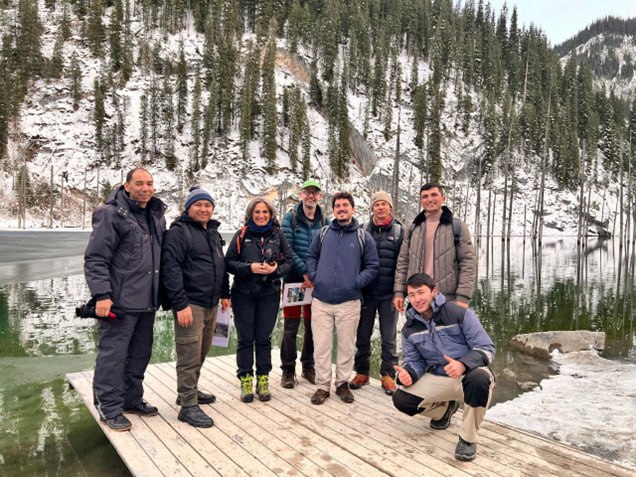


On 10th of November, a ten-day international scientific-practical seminar dedicated to studying earthquake geology and active fault hazards began in the village of Saty, Kegen district, Almaty region of Kazakhstan. The seminar was organized within the framework of an international project of the University of Oxford, in cooperation with the National Nuclear Center of Kazakhstan. More than 40 specialists from the United Kingdom, Italy, Greece, Poland, Chile, Georgia, Armenia, Azerbaijan, Turkmenistan, Uzbekistan, Tajikistan, Kyrgyzstan, and Kazakhstan are taking part in the international seminar, including staff members of the Institute of Seismology of the Academy of Sciences of the Republic of Uzbekistan.
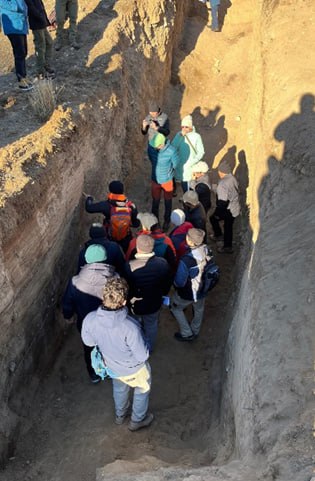
Seminar participants are studying the Saty active fault zone by applying drone, lidar, and GNSS technologies to identify traces of historical earthquakes. They excavated a geological trench perpendicular to the fault trace to document evidence left by strong past earthquakes, map the trench walls, determine the age of sediment layers through sampling, and create three-dimensional trench models using 3D scanning.
Field studies are also being carried out in the Saty fault zone using geological, geomorphological, tectonic, geophysical, and space-geodetic methods. The area is known for high geodynamic activity and was the source of several major earthquakes in recent history, including the Verny earthquake (Mw 7.3, 1887), the Chilik earthquake (Mw 8.2, 1889), and the Kemin earthquake (Mw 7.8–8.0, 1911). The practical seminar offers young specialists valuable opportunities to assess seismic hazard, study modern methods in geology, tectonics, geophysics, and space-geodesy, and strengthen international collaboration.
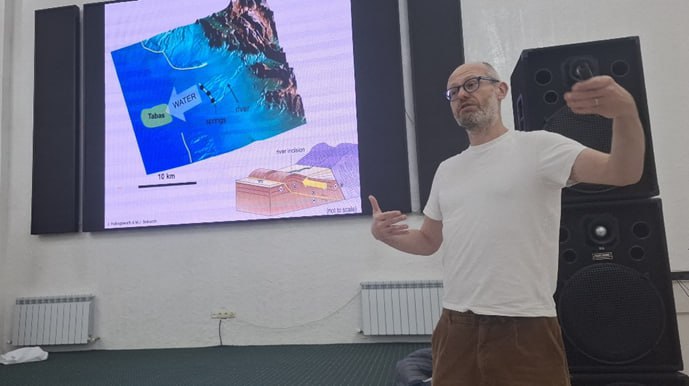
Participants are actively taking part in the lectures and practical sessions led by Professor Richard Walker of the University of Oxford.
Seminar participants are studying the Saty active fault zone by applying drone, lidar, and GNSS technologies to identify traces of historical earthquakes. They excavated a geological trench perpendicular to the fault trace to document evidence left by strong past earthquakes, map the trench walls, determine the age of sediment layers through sampling, and create three-dimensional trench models using 3D scanning.
Field studies are also being carried out in the Saty fault zone using geological, geomorphological, tectonic, geophysical, and space-geodetic methods. The area is known for high geodynamic activity and was the source of several major earthquakes in recent history, including the Verny earthquake (Mw 7.3, 1887), the Chilik earthquake (Mw 8.2, 1889), and the Kemin earthquake (Mw 7.8–8.0, 1911). The practical seminar offers young specialists valuable opportunities to assess seismic hazard, study modern methods in geology, tectonics, geophysics, and space-geodesy, and strengthen international collaboration.
Participants are actively taking part in the lectures and practical sessions led by Professor Richard Walker of the University of Oxford.